
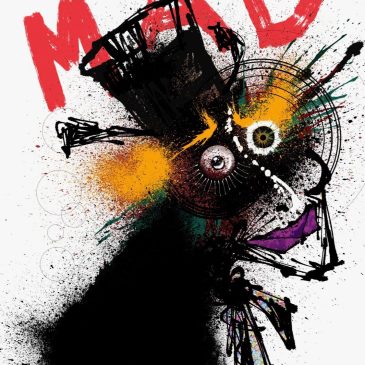
Mad Studies is a social movement which seeks to use lived experience to critique dominant ‘psy’ discourses surrounding experiences of distress. In order to achieve this Mad Studies has looked to become a knowledge base constituting an in/discipline on the borders of academia. The purpose of this is to find a way to challenge ‘expert’ portraits of distress, which too often paint life in a normative fashion, that fails to respect the reality of the lived experience of those who have suffered or continue to do so. Within a normative model, ‘patients’ are often presented as exhibiting some malady that may be corrected with the correct biopsychosocial intervention and so become an object to be cured, instead of a human to be understood. This is particularly problematic with the biopsychosocial model itself often being a fallacy, with psychological and social interventions either not being provided or being seen as less significant than pharmaceutical provisions.
Therefore Richard Ingram has argued that we need to be allowed to make (non)sense together, in which we question the value of ‘coherence’, instead creating spaces where we are able to be more genuinely authentic. A part of this requires Mad Studies to maintain its roots in community engagement but also to practise a ‘sly normativity’ in academia. Mad practitioners can show there is some method in the madness whilst simultaneously preserving the madness in the method. One means of achieving this could be producing work that resembles other bodies of knowledge, with such mimicry potentially having a subversive effect on wider academia. This is likely to lead to criticism, not just from psychiatry, but other academics who feel threatened by a challenge to their processes.