
Radical Psychoanalysis

Radical psychoanalysis is aligned with Mad ideals. It looks to move beyond an individualised, adaptive model of distress, instead developing understanding of the barriers that get in the way of us connecting with others. Radical psychoanalysis builds on Freudian notions of the unconscious but shifts its focus from something hidden inside us, to ideas that are played out relationally through our interactions with others. Radical psychoanalysis argues that it is only by understanding the ways we have been blindsided by and internalised oppressive practices that we can grow to offer the zeal necessary to bring about social change. It is important to note that psychoanalytic concepts can cause problems when applied to the world outside the clinic and are more a way of rendering our relationship with ourselves, and by extension others, more clear.

We can understand this if we consider how psychoanalysis in its history has regularly been aligned with an ethics of power and domination. In which the psychoanalyst used their position to define people’s worldviews in less than helpful ways. This is despite psychoanalysis often also being associated with emancipatory ideals, as the analysts would hear the concerns their patients brought to the clinic and see that the distinction between ‘external reality’ and ourselves is not clear cut but something we actively create and creates us.


Alienation

Whereas psychology and psychiatry are interested in helping us to adapt to the current ways things are, often reinforcing feelings of alienation, radical psychoanalysis looks to provide the tools through which we can constructively work with conflict within ourselves and consequently between ourselves and others. That is, it understands that symptoms are not ‘facts of life’ but socially situated feelings towards the world. This allows for a questioning of that which is taken for granted. Inviting us to ask whether things have to be the way they are and ways in which we can strive for a more just global society. So, offering a way in which we can connect our internal struggles with wider efforts to bring about change.


The Ego

In the modern age the ego, our sense of self, is regularly promoted as the sight of rationality and by extension our very humanity. This is the site of inquiry for the psy sciences, who essentialise humanity as the workings of complicated machines to be tinkered with to achieve optimum efficiency. This is a mere caricature of life and beyond just being a poor reflection of how experiences are actually lived but under its prestigious weight can crush divergent ideas of what the good life could mean. That is, if life becomes a service to a ‘rationally’ attuned ego, we risk failing to see how ideas of what is rational are politically and culturally created. Threatening to shut us off from others and a full experience of life.

This shows how radical psychoanalysis offers a pathway to foster our own sense of self in the world not just by looking inwards but in how we exist in a dialogue with the world in which we live. By offering a critique of how this is morphed by power, radical psychoanalysis can move us away from navel gazing and encourage us to find ways to connect to others and their struggles as a way of finding meaning. Although this should not be seen as coming easily, with division central to all our experience (we can only ever communicate part of a whole for example), it offers an aspiration that speaks to the heart of Mad Studies and the Mad movement. 


Reading

For an introduction to these ideas try Ian Parker’s and David Pavón-Cuéllar’s, Revolution and Psychoanalysis.


Recovery

The development of the recovery narrative was seen as a way of moving beyond notions that those who have experienced extreme forms of distress are essentially ‘broken’ and can instead go on to build a meaningful life autonomously. It was developed in a context in which psychiatric ‘care’ was heavily institutionalised and imagined a world in which service users could have choice about what went into helping them achieve their aims.


Critiques of Recovery

Whilst a recovery narrative offers the potential to provide people hope to those who may otherwise be cast aside, the initiative presents a clear example in which a concept developed out of lived experience has been co-opted and repackaged in less helpful terms. This is because it has been redeveloped out of a medical model of distress, being used to serve a medical ideology. As such successful recovery has begun to be seen as best achieved by taking your pills and getting back to work, and not a more nuanced and complex journey which might better represent somebody achieving a new sense of wellbeing.

Another means recovery narratives have struggled to live up to their early promise is the fact that those tasked to support people on their journey are often embedded in systems which have previously enacted violence on the people they are tasked to support. This can mean genuine mutual trust becomes nearly impossible to develop. The constant threat of compulsory treatment and detention leading to a culture of fear which is not appropriate for holding space for the kind of therapeutic relationships which can empower users to develop.

The Biomedical Model

The biomedical model is a way of life which places chemical balances in the brain as the key reasoning behind experiences of distress. It is a fundamentally individual way of making sense of issues people may encounter, detached from the social and psychological realities that people navigate when experiencing and making sense of their world. The biomedical model therefore posits that mental ‘disorders’ are diseases which can be treated with medication.

The biomedical model has been increasingly challenged in recent history by people in and outside the psychiatric realm. One means this has happened has been the growth in understanding of epigenetics, which show that our biological makeup is not something we are born and die with but is impacted by the environment in which we live. This goes some way to explaining why schizophrenia has been shown to have a more benign course in India than the United States for example.

The biomedical model serves as an extension of a positivist worldview, arguing that the world can be broken down into observable parts. Parts which can be expected to impact on each other in monitorable ways to lead to predictable outcomes.

Mad Studies

Mad Studies is a social movement which seeks to use lived experience to critique dominant ‘psy’ discourses surrounding experiences of distress. In order to achieve this Mad Studies has looked to become a knowledge base constituting an in/discipline on the borders of academia. The purpose of this is to find a way to challenge ‘expert’ portraits of distress, which too often paint life in a normative fashion, that fails to respect the reality of the lived experience of those who have suffered or continue to do so. Within a normative model, ‘patients’ are often presented as exhibiting some malady that may be corrected with the correct biopsychosocial intervention and so become an object to be cured, instead of a human to be understood. This is particularly problematic with the biopsychosocial model itself often being a fallacy, with psychological and social interventions either not being provided or being seen as less significant than pharmaceutical provisions.

Therefore Richard Ingram has argued that we need to be allowed to make (non)sense together, in which we question the value of ‘coherence’, instead creating spaces where we are able to be more genuinely authentic. A part of this requires Mad Studies to maintain its roots in community engagement but also to practise a ‘sly normativity’ in academia. Mad practitioners can show there is some method in the madness whilst simultaneously preserving the madness in the method. One means of achieving this could be producing work that resembles other bodies of knowledge, with such mimicry potentially having a subversive effect on wider academia. This is likely to lead to criticism, not just from psychiatry, but other academics who feel threatened by a challenge to their processes. 

The Psychiatric Subject

Understanding a psychiatric subject is a means through which to understand how power operates to create an idealised concept of what it is to be a user of psychiatric services. This can provide a critique and reconceptualisation of the foundations of the gaze which often dictates the ways in which psychiatric systems and wider societies relate to people. 

Any consideration of a ‘subject’ owes itself to the work of Michel Foucault, who spent much of his career arguing how Western societies make human beings into subjects. This, he argued, occurs in two distinct ways, either by people being subjected to others through control or dependence or by having their subjective identity tied to a specific identity. These features constitute two aspects of a single dynamic process which is mediated by power as people are either disciplined, or perhaps more insidiously, self-correct their behaviour as they see themselves as being monitored. 

This is an important argument from a Mad lens because it invites us to consider and question the ways in which psychiatrization may impact on ourselves as individuals. It for example offers an understanding through which psychiatric labelling and diagnosis may impact on us, as the power to define entangles with our self-knowledge, leading us to redefine our expectations surrounding our relationship with the world. 


Psychiatric power

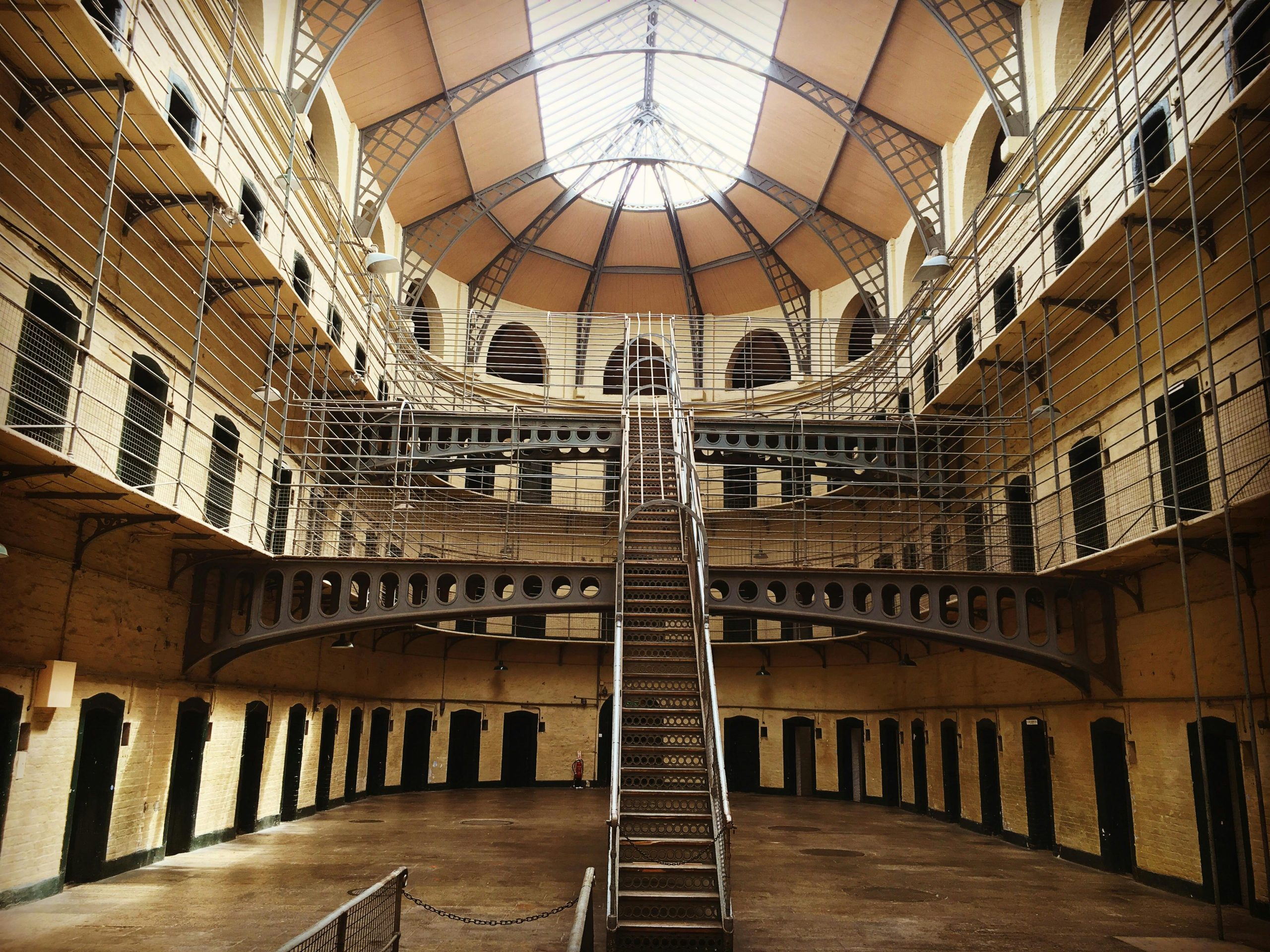
One famous example of the prevalence of disciplinary power made by Foucault was that of the panopticon, an idea for a prison originated by Jeremy Bentham in the 18th century which subjected inmates to the perpetual potential that they may be being watched. This is something is literally related to many people’s experiences on psychiatric wards, where there is a constant monitoring of people. Which can set the tone for psychiatric interventions in the community, in which psychiatric power can be experienced as a disindividualized gaze more interested in monitoring than understanding a subject.


Psychiatric knowledge

Key to Foucault’s theory is how knowledge is always a historical construction, reflecting the political interests, norms and values of the time in which it has been created. He therefore describes bodies of knowledge as a form of ‘discourse’, meaning that they are discursively constituted through the relationship between a writer and their position. Consequently something like a diagnosis can never mirror an objective reality but is built from a context in which certain behaviours are expected to be adhered to, intertwining with an individual’s subjective understanding of themself. 

This can be particularly problematic in regards to psychiatric diagnoses because of the ways they saturate people’s identity (where an illness comes to define the very being of an individual). An experience which can then be used to characterise somebody, as for example being dependent on others and requiring paternalistic support. Such a process is a way in which discussions around what it means to suffer from unusual manifestations of distress leads to the wielding of psychiatric power a way that changes somebody’s self-identification. 

It would however be simplistic to see power-knowledge relations as determining either an individual’s self-identification or their relationship to others. Instead, understanding how these processes can operate can be a means through which to see a potential site of resistance for challenging sanist and limiting rhetoric surrounding Mad persons. It can for example be a significant development to hold epistemic humility by accepting that psychiatric constructions are historically situated and so malleable and open to change. An idea that is further reflected in any understanding of a psychiatric subject, in which clear labels cannot be placed but each individual can be seen in a dynamic state of ‘becoming’.

It is also important to accept that whilst terms and understanding are constructed in relation to power, we still need some way of defining our experiences and relating to each other. Understanding these processes does not change that fact but may serve as inspiration for creating new power bases in which we can redefine the potential implications of improving dialogue between persons. Subsequently, it is not the knowledge that is used that is potentially problematic but the ways in which it is operationalised. Meaning challenging polemical practitioners who utilise knowledge in dogmatic ways is important to prevent them wielding discourses for their own, and not collaborative, ends. 

Survivor Knowledge

Survivor knowledge has for a long time been devalued in research, with critics arguing that it places somebody ‘too close’ to their inquiry and so undermines their ability to reach objective conclusions. This view can be seen as an extension of the positioning of positivist research as superior to other forms of knowledge. It is a perspective which invalidates those who often hold the most knowledge about a subject area, as it denies their credibility to know about things which directly impact upon them. 

However, survivor knowledge is a key means through which we can harness insights into the ways in which things can be different to build more personable mechanisms for supporting those who may be experiencing distress. Understanding this threatens to disrupt long held notions of what good research entails, painting a picture in which the shorter the distance between the knower and generated knowledge, the less distorted, inaccurate and damaging it is likely to be. This runs counter to the assumptions of ‘scientific’ knowledge, which argue that it is only through a detached reason that we can reach genuine understanding.

The subjugations of certain knowledge relate to ideas of power-knowledge and the ways in which certain understandings are not seen as legitimate, with experiential knowledge in particular only seen as valid when it is corroborated by other means. Whilst it is still necessary to be in some way systematic in order to avoid personal biases clouding judgement, reconsidering the philosophy that sees distance as good and experience as bad could be revelatory for how we undertake social science, particularly where it is expected to intervene in somebody’s life.

It is also worth bearing in mind that all knowledge is open to question, with it often being that certain ‘truths’ only become apparent retrospectively. Whilst all forms of knowledge production can be victim to biases clouding its validity. This is apparent if we consider RCTs, seen by many to be the cornerstone of vigorous research, which have regularly been questioned for being influenced by the pharmaceutical industry and the ideological framework in which researchers on such projects operate. 

Earmarking a new philosophy for knowledge creation around experiences of distress has practical concerns for the delivery of services and the wider psychiatric system. This is apparent if we consider how interventions are regularly touted as needing to be ‘evidence-based’, and emphasising the significant contributions survivor knowledge can make disrupts what counts as evidence. Something which, taken further, invites practitioners to base interventions more on their relational understanding of a service user than the words in a textbook. An idea which highlights how we can all empathise with others better if we allow ourselves to first get closer to our own experiences by making space to interpret and relate them to others.


Critiques of survivor knowledge

Experiential knowledge has been criticised for only being able to talk about individual experiences. This is particularly the case as each individual can have multiple ways of interpreting their own experiences whilst the ways we talk about this can be complicated, subtle, ambiguous and sometimes unclear. This does not however have to mean that survivor knowledge need be unusable but care needs to be taken in how it is collected, with efforts being made to create a safe situation for people to share their insights in ways that remains close to how it has been felt. This means it is important to reduce the distance between an experience and its interpretation, both in time but also in context. That is, approaching survivor knowledge with scepticism may lead to a clouding of an individual’s perspective and see them adjust their experience or memory in a way that makes the knowledge less valid.