Understanding a psychiatric subject is a means through which to understand how power operates to create an idealised concept of what it is to be a user of psychiatric services. This can provide a critique and reconceptualisation of the foundations of the gaze which often dictates the ways in which psychiatric systems and wider societies relate to people.
Any consideration of a ‘subject’ owes itself to the work of Michel Foucault, who spent much of his career arguing how Western societies make human beings into subjects. This, he argued, occurs in two distinct ways, either by people being subjected to others through control or dependence or by having their subjective identity tied to a specific identity. These features constitute two aspects of a single dynamic process which is mediated by power as people are either disciplined, or perhaps more insidiously, self-correct their behaviour as they see themselves as being monitored.
This is an important argument from a Mad lens because it invites us to consider and question the ways in which psychiatrization may impact on ourselves as individuals. It for example offers an understanding through which psychiatric labelling and diagnosis may impact on us, as the power to define entangles with our self-knowledge, leading us to redefine our expectations surrounding our relationship with the world.
Psychiatric power
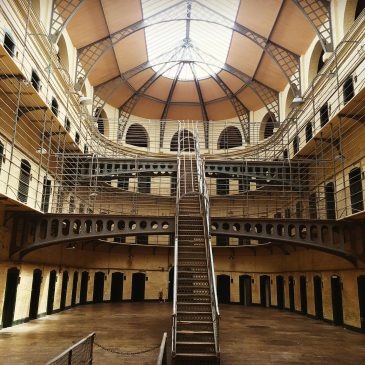
One famous example of the prevalence of disciplinary power made by Foucault was that of the panopticon, an idea for a prison originated by Jeremy Bentham in the 18th century which subjected inmates to the perpetual potential that they may be being watched. This is something is literally related to many people’s experiences on psychiatric wards, where there is a constant monitoring of people. Which can set the tone for psychiatric interventions in the community, in which psychiatric power can be experienced as a disindividualized gaze more interested in monitoring than understanding a subject.
Psychiatric knowledge
Key to Foucault’s theory is how knowledge is always a historical construction, reflecting the political interests, norms and values of the time in which it has been created. He therefore describes bodies of knowledge as a form of ‘discourse’, meaning that they are discursively constituted through the relationship between a writer and their position. Consequently something like a diagnosis can never mirror an objective reality but is built from a context in which certain behaviours are expected to be adhered to, intertwining with an individual’s subjective understanding of themself.
This can be particularly problematic in regards to psychiatric diagnoses because of the ways they saturate people’s identity (where an illness comes to define the very being of an individual). An experience which can then be used to characterise somebody, as for example being dependent on others and requiring paternalistic support. Such a process is a way in which discussions around what it means to suffer from unusual manifestations of distress leads to the wielding of psychiatric power a way that changes somebody’s self-identification.
It would however be simplistic to see power-knowledge relations as determining either an individual’s self-identification or their relationship to others. Instead, understanding how these processes can operate can be a means through which to see a potential site of resistance for challenging sanist and limiting rhetoric surrounding Mad persons. It can for example be a significant development to hold epistemic humility by accepting that psychiatric constructions are historically situated and so malleable and open to change. An idea that is further reflected in any understanding of a psychiatric subject, in which clear labels cannot be placed but each individual can be seen in a dynamic state of ‘becoming’.
It is also important to accept that whilst terms and understanding are constructed in relation to power, we still need some way of defining our experiences and relating to each other. Understanding these processes does not change that fact but may serve as inspiration for creating new power bases in which we can redefine the potential implications of improving dialogue between persons. Subsequently, it is not the knowledge that is used that is potentially problematic but the ways in which it is operationalised. Meaning challenging polemical practitioners who utilise knowledge in dogmatic ways is important to prevent them wielding discourses for their own, and not collaborative, ends.